CMORoom Spotlight: Raul Ruiz, CMO, Lenox Corporation Raul Ruiz
The New Playbook for Legacy Brands
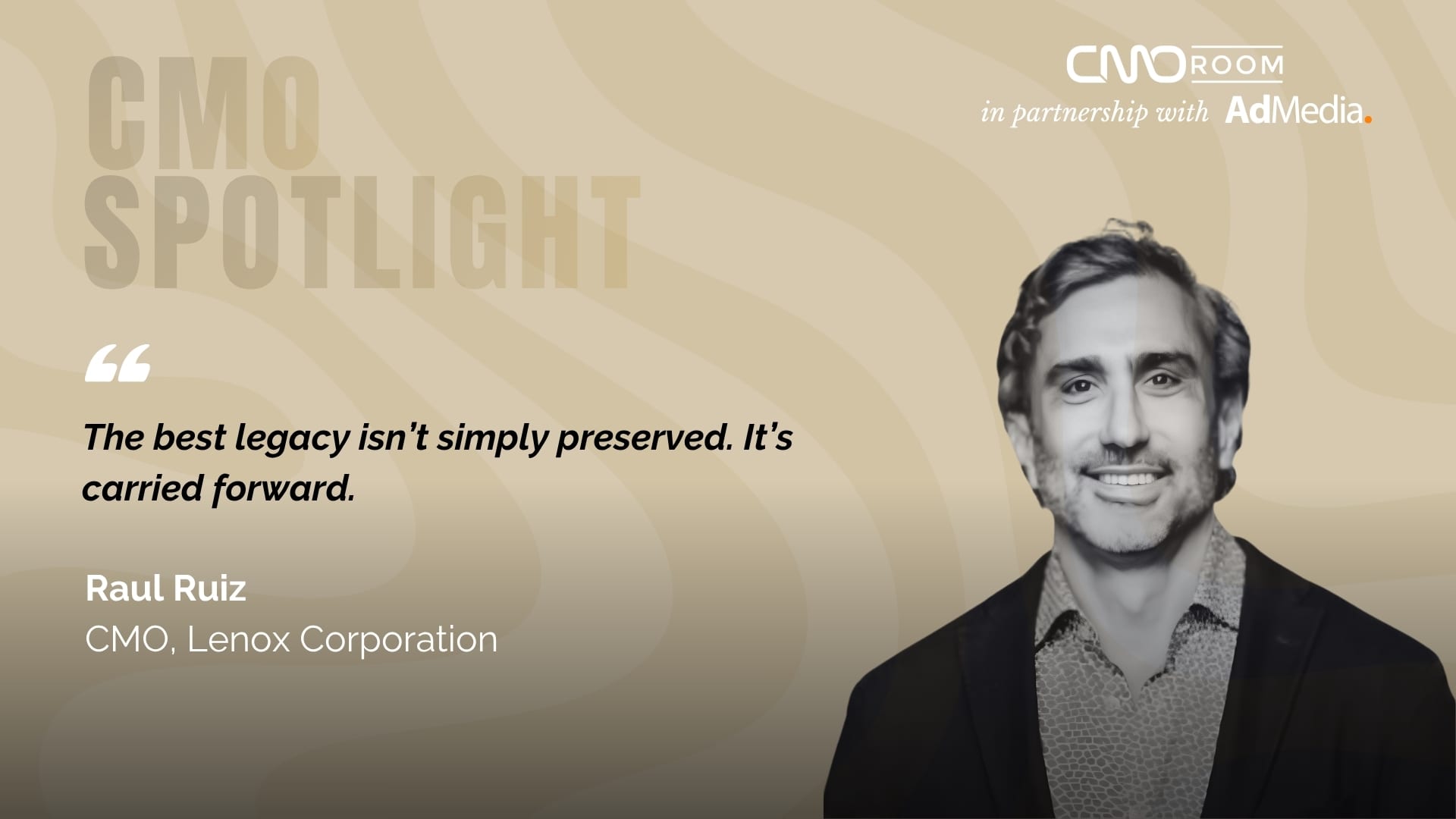
How do you take a brand with decades, or even centuries, of history and make it feel relevant to the consumer of tomorrow? For Raul Ruiz, Chief Marketing Officer at Lenox Corporation, the answer isn't to leave heritage behind. It's to find new meaning within it.
Ruiz has built his career across some of America's most recognizable consumer brands, from Sharpie and Modelo Especial to Corona Extra, Instant Pot and now Lenox. Along the way, he's worked across product, trade and brand marketing, building a perspective shaped as much by business fundamentals as by consumer insight. His current mandate at Lenox brings a particularly interesting challenge: taking storied brands and translating their legacy into elevating everyday moments and becoming culturally relevant with today's consumers to take more share of occasions.
Recent work across Lenox, Oneida and Reed & Barton reflects that philosophy. Whether it's reframing Lenox around "Bringing Beauty to Every Table", positioning Oneida around "Made For Every Moment," or bringing craftsmanship to life through Reed & Barton's "Linger on Every Detail," the strategy is consistent: heritage only matters when it has meaning in the present.
We sat down with Raul to explore what modern brand building looks like when consumers are changing faster than the brands themselves.
Q: You've worked across categories ranging from office supplies and beer to kitchen appliances and luxury home goods. What has that variety taught you about building brands?
One of the biggest lessons is that while categories change, the fundamentals of marketing don't. At the center of every great brand is an understanding of the consumer: what they need, what motivates them, what tensions exist in their lives, and what role the brand can authentically play.
I've had the opportunity to work across product marketing, trade marketing and brand marketing, and each experience has given me a different perspective on how consumers interact with products and brands. The more categories you work across, the more you realize that marketing isn't really about the product category. It's about understanding people and finding the right way to create value for them.
Q: Lenox is a brand with more than a century of history. How do you modernize a heritage brand without losing what made it valuable in the first place?
I don't think modernization means reinventing everything. Heritage is an incredible asset, but it can also become a constraint if we only talk about the past. The opportunity is to understand what made the brand meaningful historically and then translate that into today's culture.
With Lenox, for example, the brand has been part of meaningful moments for generations. But the way people live, entertain and gather has changed. The question becomes: how do we take that same idea of beauty, craftsmanship and meaningful moments and make it relevant to how people live today? That's where the work becomes exciting. We're not abandoning the heritage. We're giving it a new reason to matter.
Q: Your recent Lenox work challenges the idea that fine tableware should be reserved for special occasions. Why is that shift important?
Because consumers are redefining what a meaningful moment looks like. For a long time, fine tableware was associated with weddings, holidays and formal occasions. But today's consumer may be just as interested in creating a beautiful experience on an ordinary Tuesday night.
That creates an opportunity for the brand.
Instead of asking consumers to wait for a special occasion, we can show them that everyday moments deserve to be elevated too. That's the thinking behind "Bring Beauty to Every Table."
We're not simply talking about plates or tableware. We're talking about atmosphere, rituals and the emotional experience around the table.
Q: Oneida is another example of a legacy brand being repositioned around contemporary consumer behavior. What role does consumer insight play in that process?
Consumer insight has to be the starting point.
One of the things we recognized with Oneida was that tableware is an incredibly functional category, but consumers don't necessarily want their lives to feel purely functional. People want products that fit seamlessly into their lives, from a weekday breakfast to a birthday celebration to an impromptu dinner with friends.
That led us toward the idea of "Made for Every Moment."
The opportunity was to take something people already understood, durability, craftsmanship and dependability, and connect those functional equities to a much broader emotional role. That's when a product starts becoming more than a product.
Q: You've also worked extensively with partnerships, from cultural and entertainment platforms to major brand collaborations. What makes a partnership genuinely valuable to a brand?
A partnership has to create something that neither brand could create as effectively on its own. It's easy to partner simply because two brands have compatible audiences. But the more interesting question is: what new meaning can we create together?
The McCormick Gourmet and Lenox Spice Village collaboration is a good example. One brand brings expertise in flavor and culinary culture. The other brings design, collectibility and storytelling. Together, you create an experience that crosses categories.
That's where partnerships become powerful. They're not just distribution mechanisms. They can actually change how consumers see a brand.
Q: You've talked about cultural relevance as a major part of modern brand building. What does cultural relevance actually mean to you?
Cultural relevance isn't about chasing every trend. It's about understanding how people are living and finding authentic ways for your brand to participate.
That distinction matters.
A brand can try too hard to look young or current and end up losing its credibility. The goal should be to identify where culture is moving and determine whether there's a genuine role for your brand within that movement. For heritage brands especially, that balance is critical. You want to reach new audiences without pretending to be something you're not.
Q: You've built brands in very different environments. How has the role of the CMO changed?
The CMO has to be increasingly comfortable connecting brand and business. Marketing can't operate in isolation anymore. You need to understand the consumer, the brand, the P&L, the channels, the customer and the broader business strategy.
I've always believed that great marketing has to create both emotional and commercial value. You need the big idea, but you also need to understand how that idea translates into growth. That requires marketers to be curious about the entire business, not just the marketing department.
Q: AI, fragmentation and changing consumer behavior are forcing marketers to rethink how they work. What do you think becomes more important as technology accelerates?
Technology is going to make many parts of marketing faster and more efficient. But that makes human understanding even more important. When everyone has access to similar tools, the differentiator becomes the quality of the thinking.
Do you understand your consumer deeply? Can you identify a meaningful tension? Can you build a distinctive brand idea? Can you tell a story people actually care about?
AI can help us move faster. But it doesn't eliminate the need for judgment, creativity or empathy. If anything, those become more valuable.
Q: Looking across your career, what's one piece of advice you'd give marketers who want to become better leaders?
Stay curious.
I've been fortunate to work across different categories, companies and functions, and every transition has taught me something new. Don't become too attached to one way of doing things. Learn the business. Learn from your agency partners. Spend time with consumers. Understand the numbers. And most importantly, keep challenging yourself.
Some of the best career opportunities come when you move slightly outside of what you're already comfortable doing.
Q: Finally, what do you think the next generation of great brands will have in common?
They'll understand that relevance isn't something you achieve once.
You have to keep earning it. The strongest brands know what they stand for, but they're also willing to evolve how they express that meaning as culture and consumers change.
That's the opportunity I see with brands like Lenox. We have incredible heritage. We have incredible products. The job now is to make sure that heritage continues to live, not just in the past, but in the lives of the next generation of consumers. Because the best legacy isn't simply preserved.
It's carried forward.
The future of brand building belongs to marketers who can balance what a brand has always stood for with what consumers need from it next. Heritage can create trust, but relevance creates momentum. The brands that thrive will be those that know how to evolve without losing their identity, and turn what they’ve built over time into a reason for consumers to believe in what comes next.
CMORoom Spotlight celebrates the marketing leaders shaping what comes next, and the ideas, decisions and perspectives behind the brands we know.
